When work standards split
A real Kyuria team profile, two patterns firing at once, and what the data is actually pointing at.
Three people on a team. Their Conscientiousness scores sit at roughly the 30th, 60th, and 95th percentiles. The team average lands at the 61st, above the population mean. The spread between the most and least structured member is sixty-five points.
In Kyuria, two patterns fire on this team at the same time. The team’s average work style leans toward structure and discipline. The team also has the single strongest variance pattern in the team personality literature. Both of those things are true at once, and both of them shape how this team actually works together. Usually without anyone naming what’s going on.
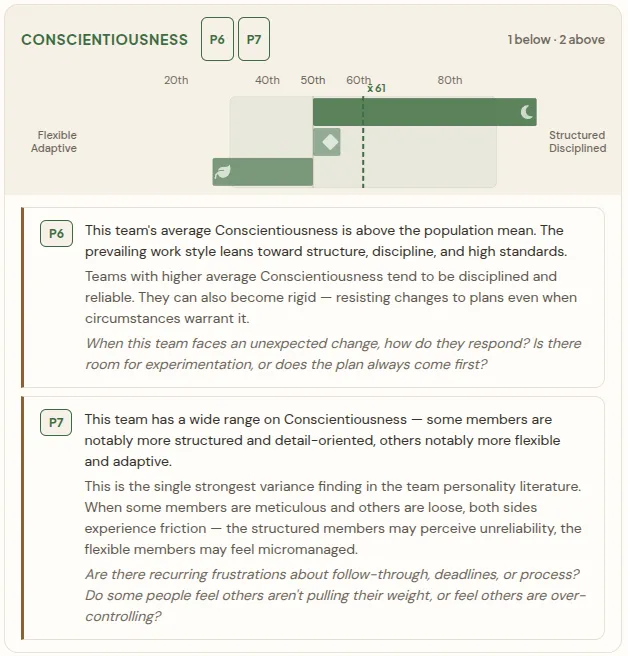
The Conscientiousness view from a real Kyuria team analysis. Two patterns surface at once: above-average mean (P6) and wide spread (P7). The team is doing both things at the same time.
The deadline problem that isn’t about deadlines
The friction on a team shaped like this almost always shows up first as small recurring frustrations that look like execution problems. They aren’t, exactly.
- ”By end of week” means different things
- To the 95th-percentile member, end of week means Friday at 5pm. To the 30th-percentile member, end of week means sometime before Monday morning is fine. Neither person is wrong. They’re using the same words to mean different things and they don’t yet know they are.
- Meeting follow-ups go unread
- The structured members send detailed summaries after every meeting. The flexible member processed the meeting in real time and doesn’t see the point of re-reading the conclusions. The structured members feel ignored. The flexible member feels managed.
- The plan and the improvisation
- The structured members invest heavily in the plan upfront and feel violated when it changes. The flexible member treats the plan as a starting point and improvises as new information arrives. The improvisation looks like unreliability from one side and like adaptability from the other.
- Different theories of what a “yes” is
- To the structured members, agreeing to something means a commitment with implied dates, deliverables, and updates. To the flexible member, agreeing to something means “I’ll work on it, and I’ll tell you if something changes.” Same word. Different contract.
What’s happening here isn’t a follow-through problem. It’s a norms problem. Until someone names that, the friction will look like one person’s deficiency.
Why this specific pattern matters
When researchers have looked at what predicts team performance from personality data, the strongest single finding isn’t about averages. It’s about spread on Conscientiousness.
The effect is large, and it’s directional. Higher variance on this trait correlates with lower team performance unless the team has built norms that accommodate both styles. That second part is the part most teams skip. The variance is structural. The norms are not.
The other pattern firing on this team, the above-average mean, is its own finding. Teams with higher average Conscientiousness tend to be disciplined and reliable, with strong follow-through. They can also become rigid, resisting changes to plans even when the situation warrants it (LePine 2003). Curşeu and colleagues (2019) confirmed the inverted-U for Conscientiousness: at moderate levels it predicts good outcomes, at extreme levels it predicts the opposite.
This team’s average isn’t extreme. The 61st percentile is above the mean, not far above it. But the prevailing direction matters. The 30th-percentile member isn’t just a single point on a chart. They’re working in a room whose other two members lean toward structure and discipline as the default. Their experience of the team is different from the team’s experience of itself.
The structured members may perceive unreliability. The flexible member may feel micromanaged. Both are right.
The questions worth asking
The patterns aren’t predictions. They’re surfaces that something underneath is worth a conversation. For a team shaped like this one, the conversations are pretty specific.
-
Do you have a shared definition of “done”? Not in the abstract. For your three or four most common deliverables, does the whole team have the same picture of what finished looks like, and the same picture of when it’s due? If you’ve never had this conversation explicitly, you probably don’t.
-
What is a commitment on your team? When someone says “yes” or “I’ll do that” in a meeting, what does each person mean by it? Is there an implicit follow-up cadence, or isn’t there? Is silence after a yes a sign of progress or a sign of trouble? The most predictable friction on a wide-spread team comes from people answering this question differently without ever discussing it.
-
Where does adaptability help you? The flexible member isn’t a problem to be managed. They’re the person most likely to notice when the plan stopped fitting the situation. Has the team built any explicit space for “let’s reopen this,” or does every change require pushing through the structure?
These aren’t recommendations. They’re the conversations the data suggests are unfinished. If the team has had them already, the patterns matter less. If they haven’t, the patterns are telling them where to look.
The split isn’t the problem. The unnamed assumptions about what the split means are.